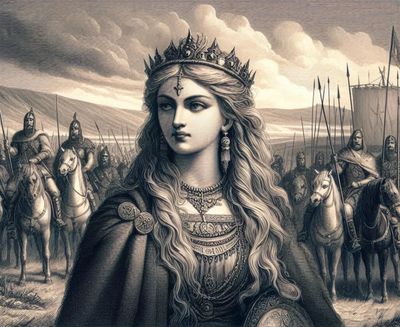
Chapter III: British Christian Beauty Catches Roman Captor
What is known of the earliest converts of the Jewish exiles who are believed to have founded the British Church? The 19th Century Welsh scholar, The Rev. R. W. Morgan, among others, makes a persuasive case that among them were close relatives of Caradoc, the British prince, who, for seven years, fought a bitter guerrilla war against the Roman invaders. Caradoc was the crown prince of the Silurian clan, and, according to Welsh annals, the first Christian converts included: his daughters, Gladys (known as Claudia) and Eurgain; his son,
Linus; and his sister, also Gladys.
Morgan and his fellow scholars cite Welsh annals that state that Caradoc and his father, Bran (venerated in Wales as St. Bran the Blessed) were converted in Rome, following their capture by the Romans in A.D. 52. They also assert that Gladys married Rufus Pudens—a member of the Roman Senate and a senior commander in the Army that conquered England—and converted him to Christianity.
We know a great deal about Caradoc’s daughter Gladys from contemporary Roman sources. She was something of a celebrity—an exotic, noble beauty from a mysterious island kingdom. Documentary records show that following her marriage, her name was Latinized to Claudia Pudentia. She became a leading figure in Rome’s fashionable society. The poet Martial wrote odes extolling her beauty.
A “Rufus” is mentioned in St. Paul’s Epistle to the Romans, Chapter 16, verse 13: “Salute Rufus, chosen in the Lord, and his mother and mine ...” And Morgan argues that this “Rufus” was actually Rufus Pudens. (Some scholars have suggested that Rufus was St. Paul’s half brother. Paul also greets another of his kinsmen, Herodian, in verse 11 of the same chapter.)
Morgan contends St. Paul lived, or was closely associated, with Rufus Pudens and members of the British royal family during his period of house arrest prior to his martyrdom. In support of this, he cites the fact that Paul includes them in his greeting to Timothy in what was probably his final letter to his young protege (II Timothy 4:21): “Do thy diligence to come before winter. Eubulus greeteth thee, and Pudens, and Linus, and Claudia, and all the brethren.” It is somewhat ironical, perhaps, but, if Morgan et al. are right, Caradoc’s son, Linus was the Linus who became the first Bishop of Rome. Could the first Pope really have been an Episcopalian?
Circumstantial evidence for a close relationship between St. Paul and the Pudens family is found in events following his execution. He is said to have been originally buried in the family’s private cemetery on the Via Ostiensis. Rufus’ and Claudia’s children, all of whom were martyred, were interred alongside him. Added to this is the strange history of Caradoc’s house: During their captivity in Rome, Caradoc and his relatives lived in the residence that his family had owned in Rome for almost a century. It had been acquired as an embassy shortly after the defeat of Julius Caesar’s invasion of Britain. This residence, located on the Mons Sacer, was known as the Palatium Britannicum. Later, its name was changed to the Titulus, then to Hospitum Apostolorum. Today it is the Church of St. Pudentiana—the church dedicated to a martyred daughter of Claudia and Rufus Pudens. Can this be pure coincidence?
What of St. Eurgain, Caradoc’s other daughter? Legends—oral history, if you will—tells us that she is the mother of Morning and Evening Prayer. She is said to have eventually returned to Britain, where she established many churches and monasteries, primarily in Wales. Each of them operated to a staggered timetable so that the Offices were continually sung throughout the 24 hours of every day, in order that “earth’s praise of God should never cease.” (Compare traditional Welsh choral music with Greek and Slavonic choral liturgies. The similarity is striking.)
Returning to less speculative realms, two British Bishops are recorded as attending the Council of Arles in A.D. 314, and it is believed that the British Church was also represented at Nicaea in A.D. 325, though documentary proof is lacking. It is also significant, perhaps, that, in the 4th Century, a British–born Emperor, Constantine, recognized Christianity as an official religion and paved the way for its establishment as the religion of the Roman Empire. (Constantine’s mother, St. Helena, is believed to have been British. A devout Christian, she is remembered for discovering the True Cross.)
In the 5th Century, the British Church was a major center of intellectual and theological debate. Indeed, a British monk named Pelagius gave his name to a major heresy. Pelagianism is the notion that man can save himself through his own efforts. And this, of course, brings us to within spitting distance—a century or so—of St. Augustine’s arrival in a supposedly wholly pagan island.
Scholars have a clear idea of the manner in which the British Church operated. The Confessions of St. Patrick, for example, indicate services were conducted in the vernacular. In old age, Patrick grumbled that his native Latin had been ruined by years of speaking the barbarous Irish tongue. His Confessions—perhaps better described as his autobiography—show he wasn’t exaggerating. His Latin is, indeed, execrable.
The practice of saying the liturgy at least partially in the vernacular seems to have been continued into the Middle Ages when the Epistle and Gospel were often read in the vernacular during parochial Masses. Cranmer, by the way, re-instituted this ancient practice as a temporary measure before the Prayer Book of 1549 was authorized.