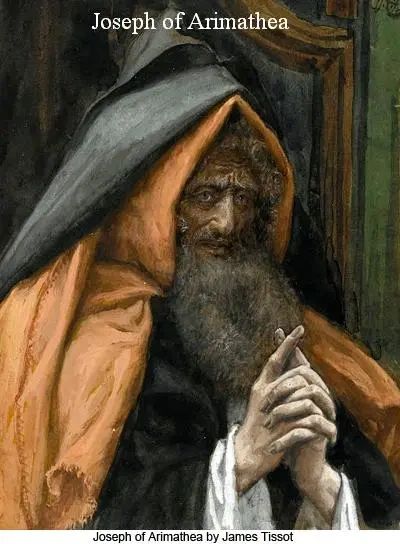
Chapter I: Joseph of Arimathea and the Metals Trade
Since its earliest recorded history, the English Church has asserted that it was founded by St Joseph of Arimathea, Our Lord’s uncle, “immediately after the passion of Christ”— (“statim post passionem Christi”).
This had never been disputed until it was challenged for political purposes by France and Spain in 1409. The antiquity of the English Church, however, was unequivocally affirmed by five Papal Councils—the Council of Pisa (1409), the Council of Constance (1417), the Council of Sens (1418), the Council of Sienna (1424), and the Council of Basle (1434).
The five councils ruled that the English Church is the oldest Church in the gentile world—despite the fact it would have been politically advantageous for the Pope to have obliged two such powerful and influential nations as France and Spain Thus, it seems fair to assume that the documentary evidence in favor of the English claim must have been overwhelming.
Sadly, much of that evidence is now lost to us, destroyed during Henry VIII’s dissolution of the religious houses, as well as during the English Civil War in the 17th Century, when ancient documents were used to make cartridges. Even so, a strong body of evidence remains: Ancient Welsh annals, writings of the Early Church Fathers, early British historians, archaeological discoveries, and oral history. All lend credence to legends that the British Church was established by St. Joseph sometime between A.D. 36 and A.D. 39, shortly after the Resurrection.
The earliest surviving historical records of the British Church were compiled long after the events that they describe took place. Gildas wrote in the 6th Century, as did Maelgwyn of Llandaff, also known as Melchinus, uncle of St. David.
It is, however, quite clear from the works of these early scholars that they were writing genuine history, and that they relied heavily upon very much older documentary sources. Some scholars, for example, believe Maelgwyn was merely quoting an earlier Maelgwyn, known as Maelgwyn of Avalon (or Glastonbury), who lived and worked in the First Century.
To a considerable extent it is possible to reconstruct much of the early history of the English Church through what is known as “oral history.” This is the historical record painstakingly sifted from the myths and legends that, in the early years at least, were passed on by word of mouth by illiterate people. It is well established that societies in which reading and writing are unknown are, nonetheless, able to transmit history with remarkable accuracy though many generations. As a consequence, oral history has proved a valuable academic tool—most notably in the realm of social history.
Treated with appropriate caution, it can provide scholars with an accurate picture of historical events for which no firsthand documentary records exist.
Oral history offers strong support for the assertion that the British Church was established by St. Joseph of Arimathea—who begged Christ’s body from Pontius Pilate—shortly before the Romans invaded Britain. The legends of St Joseph’s presence in Britain are exceedingly ancient in origin.
At this point it is worth asking: Why would St. Joseph have come to Britain? A number of the early fathers of the Church record that St. Joseph suffered persecution, along with other leading Christians and was compelled to flee the Holy Land. Legend—or oral history—says that he fled to Britain, because he was a metals trader who had frequently visited the British Isles and knew them well. Fleeing to Britain made sense. At the time of his supposed arrival—about A.D. 37—Britain was not part of the Roman Empire. The Roman armies did not invade until A.D. 45. And the Celtic population was not subdued until A.D. 52, when their military leader Caradoc (or Caratacus, as Tacitus calls him), Crown Prince of the Silurian Clan, was betrayed and captured.
Welsh scholars contend that the rapid spread of Christianity throughout the Britain is
explained by the fact that the indigenous druidic religion worshipped a trinitarian God, one
person of which was known as “Yesu.”
Moreover, the druidic teachings echoed those of The Bible—among them that man’s responsibility to God superseded his duty to the civil authority. Claims that druidism was Christianity awaiting the coming of Christ might be somewhat fanciful. But it’s interesting to note that the Romans were generally tolerant of foreign religious cults and that during the period of the empire only two religious cults were officially
suppressed: druidism and Christianity.
How much of this can be scientifically attested? Not a great deal. However, the remains of a small wattle and daub church has been excavated at Glastonbury, where St. Joseph is said to have settled. It is claimed archaeological evidence dates it to a time shortly before the Roman invasion of A.D. 42. Christian symbols, moreover, have been also discovered on artifacts recovered from a Roman fort at Carleon, in Wales, thought to have been destroyed towards the end of the First Century.
What can be documented is that numerous early Fathers of the Church have left writings confirming the early arrival of Christianity to Britain. They include Clement, 3rd Bishop of Rome, in A.D. 96; Irenaeus, Bishop of Lyons, A.D. 180; Tertullian of Carthage, A.D. 192; Origen of Antioch, A.D. 240; Dorotheus, Bishop of Tyre, A.D. 300; and Eusebius of Caesarea, A.D. 320. Heretics seem to be regarded as more trustworthy that the orthodox these days, so here’s what the heretic Sabellius—excommunicated by Pope Callixtus in A.D. 220—had to say on the subject: “The first nation that proclaimed [Christianity] as its religion, and called itself Christian, after the name of Christ, was Britain.”